Jurrien Timber carried Arsenal's attack in Champions League vs. Leverkusen, and that's a problem for Gunners
Published on Thursday, 12 March 2026 at 9:42 am
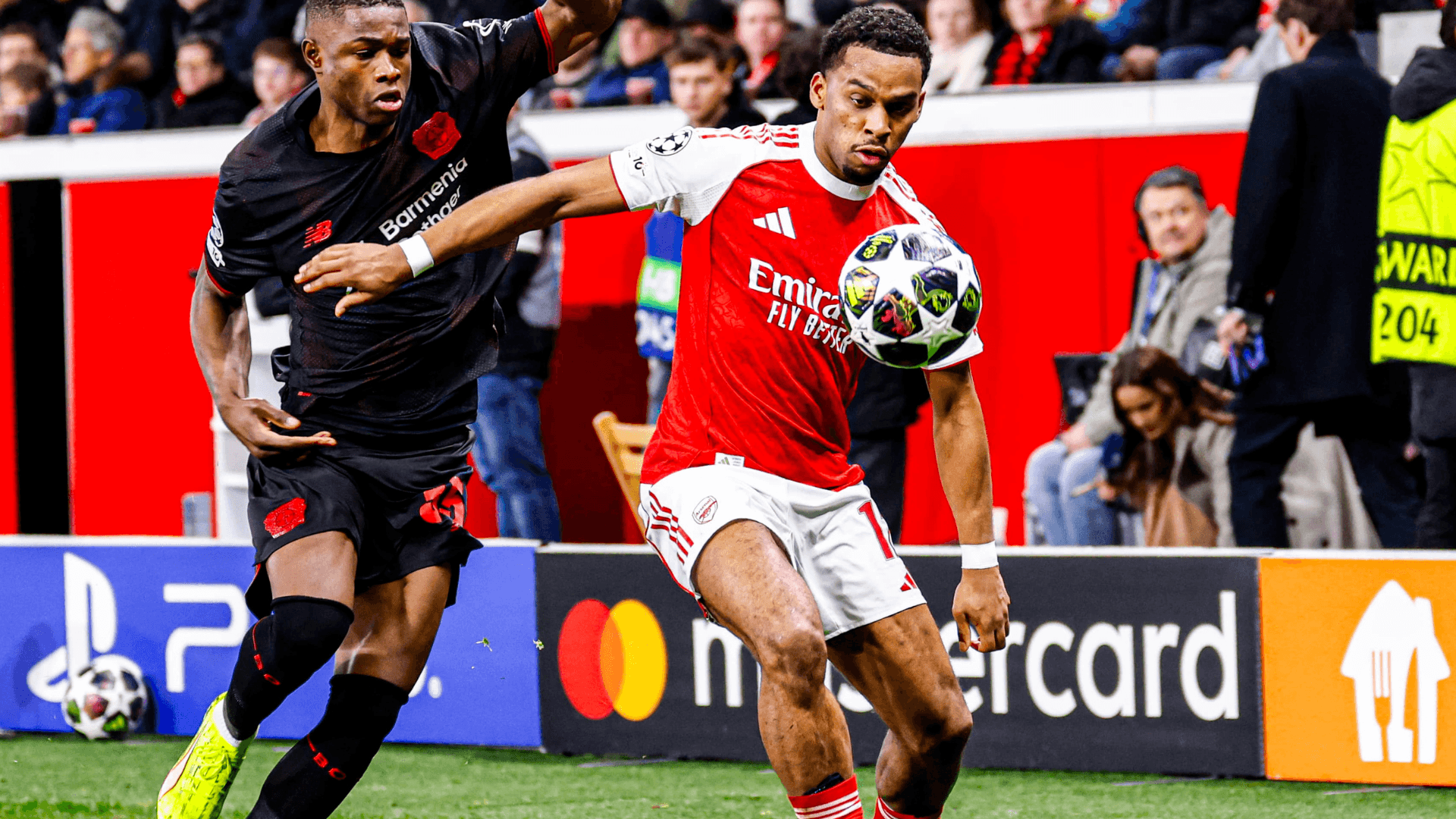
BayArena, Leverkusen — For 89 minutes Arsenal’s Champions League last-16 first leg felt like a tactical riddle without a solution, and the most telling clue was the identity of the player who kept appearing in the most valuable patches of grass: right-back Jurrien Timber.
By the final whistle the Dutchman had registered four penalty-box touches from open play, the same number as marquee summer signings Viktor Gyokeres and Bukayo Saka combined. He also supplied Arsenal’s only shot between the 48th and 89th minutes, a blocked effort that summed up an evening of sterile domination. Kai Havertz’s late penalty, earned by Noni Madueke’s surge into the box, salvaged a 1-1 draw but could not mask the structural issue that saw Xabi Alonso’s side happily concede the flanks only to choke the central lanes.
Mikel Arteta’s game model invites the full-backs to push high when opponents defend in a back five, and Leverkusen’s three-man centre-back unit duly funnelled play wide. Yet the frequency with which the ball reached Timber in advanced zones bordered on the pathological. Martin Zubimendi’s cute first-time flick found the defender unmarked inside the box early on; Timber’s heavy touch and miscued cross were emblematic of the Gunners’ blunt edge.
Context matters: Timber has contributed four goals and six assists in all competitions this season, and his byline deliveries have become a legitimate weapon. Still, the numbers show he is now averaging more penalty-area touches per 90 than any Arsenal full-back of the Emirates era, eclipsing the peaks of Ben White (≈2) and Oleksandr Zinchenko (≈1.5). Even Riccardo Calafiori, lauded for his wand of a left foot, trails Timber by roughly 10 percent in Premier League sample size.
The heart of the problem lies in the spaces just inside the D, the zones where Martin Odegaard ordinarily crafts triangles with Saka. With the club captain again sidelined, Arsenal lacked a tempo-setter and slid into what analysts dub “the horseshoe of death”: sideways passes between centre-back and full-back, centre-back and full-back, ad infinitum. Eberechi Eze and Gyokeres repeatedly dropped deep searching for oxygen, only to find Timber already stationed where a No. 10 or inverted winger should be.
Arteta will argue that Timber’s presence in those pockets is by design, a mechanism to overload the half-space against a back five. The counter-argument came in the 89th minute: Madueke, a forward, drove at tired calves and won the spot-kick that Havertz converted. It was the first time Arsenal had looked like scoring from open play since Timber’s own blocked attempt 40 minutes earlier.
Post-match data showed the Gunners finished with six shots, their lowest total in a Champions League fixture since 2023. Timber’s industry is not in question; his role as de-facto creative hub is. Until Odegaard returns—or until Arteta rebalances the structure—Arsenal risk turning their most progressive defender into an accidental attacking talisman, a scenario that plays directly into the hands of organised defenses.
The tie is delicately poised ahead of the second leg in north London. If Timber is still leading the club’s penalty-box touch charts by then, Arsenal’s European ambitions may hinge on a solution no coach truly wants: a full-back forced to play like a playmaker because no one else can.
SEO Keywords:
ArsenalJurrien TimberChampions LeagueBayer LeverkusenMikel ArtetaMartin OdegaardBukayo SakaViktor Gyokerespenalty box touchesfull-back attack2026 UCLtactical analysisGunners problemsNoni MaduekeKai Havertz
Source: cbssports