
← All Articles
Page 1 of 1Olympics News
Ilia Malinin leaves Milan Cortina Olympics behind with world championship

Prague—Ilia Malinin stood alone at center ice inside the O2 Arena on Saturday night, exhaled once, and began to speak the first line of his free-skate soundtrack to a hushed crowd.
“The only true wisdom is in knowing you know nothing.”
Six weeks after a calamitous Olympic free skate in Milan dropped him from gold-medal favorite to eighth place, the 21-year-old American used the same words as both shield and springboard, delivering a performance that re-asserted his supremacy and delivered a historic third consecutive world title.
Malinin’s program—five clean quadruple jumps book-ended by his trademark backflip—earned 218.11 points and lifted his overall total to 329.40, a 22-point margin over Japan’s Yuma Kagiyama and the largest victory cushion of his senior career. The triumph makes Malinin the youngest man to three-peat at the ISU World Figure Skating Championships since 2000 and instantly reframes a season that had veered off script in Italy.
“I just wanted to get through the long program in one piece,” Malinin said minutes after sealing the win. “That happened—and a little more.”
The path to Prague was anything but certain. After a shaky short program in the Olympic team event, Malinin rebounded to help the United States claim gold. Confidence restored, he carried a five-point lead into the individual free skate and appeared poised to cap his debut Games with a coronation. Instead, two early falls sent him tumbling to eighth, a result that left him stunned at the boards, head buried in his hands.
“I thought I could treat it like any other competition,” he admitted afterward. “But the Olympics overwhelmed me; I felt zero control.”
Rather than retreat, Malinin stayed in Milan, cheering teammates, granting interviews and, according to 1984 Olympic champion Scott Hamilton, quietly hoping for an invitation to the closing gala so he could skate one last time in front of the Olympic audience. The invite arrived; the standing ovation that followed became his launching pad toward redemption.
Thursday’s short program in Prague offered the first test. Malinin responded with a personal-best 111.29, punctuated by a quadruple flip and a quad lutz-triple toe loop combination. The wide smile he wore at the final pose told the story of a skater who had relocated his joy.
By Saturday the tension had evaporated. Skating last, Malinin attacked from the opening chord. He drilled five quads, rose from the ice for his backflip, and thumped both fists to his chest as the music faded. The score—though below his season’s best—was more than enough to secure the three-peat and send a message to every would-be challenger.
Malinin, who has not lost a competition since 2023, now owns two world crowns plus the Olympic team gold. He has hinted at quintuple jumps in training and, with the 2030 Games on the horizon, appears motivated to expand a résumé many already consider generational.
“There’s still a lot left for me to show,” he said. “Please stay tuned—don’t go anywhere.”
Ilia Malinin has left the heartbreak of Milan behind; the sport he has redefined is already looking toward what comes next.
Read more →Ilia Malinin Shrugs Off Worlds Pressure After Olympics, Calls It “Easy”

Prague—Ilia Malinin stepped onto the 2026 World Figure Skating Championships ice looking nothing like the skater who crumbled under Olympic lights four weeks earlier. The 21-year-old American responded to that disappointment in Beijing—where a calamitous free skate plunged him to an eighth-place finish—by delivering the most commanding performance of his career and capturing a third consecutive world title with a combined score of 329.40 points.
Malinin opened the event with a personal-best 111.29 in the short program and widened his lead in Thursday’s free skate, cleanly landing a program stacked with quadruple jumps that left the field in his wake. The victory, achieved while Olympic champion Mikhail Shaidorov sat out, re-established Malinin as the undisputed leader of men’s figure skating and, more importantly, signaled a mental reset after the crushing weight of the Winter Games.
“This was prob one of the easier Worlds I’ve been to just because the amount of pressure at the Olympics,” Malinin said in a post-competition interview that is already reverberating through the sport. “Coming here, it felt like no pressure at all. I blocked out all the pressure people put on me, and skated for myself. Part of why I love this sport is that I love watching skating—I was able to watch people skate and wanted to fight for everything.”
The comments mark a stark contrast to the narrative that engulfed Malinin in February, when his heavily favored Olympic campaign unraveled in the free skate and raised questions about his ability to handle the sport’s biggest moments. In Prague, he appeared liberated, skating with the freedom and joy that had been absent in Beijing and finishing well ahead of his nearest challengers.
If Malinin’s newfound mental equilibrium proves lasting, the rest of the competitive landscape faces a daunting reality: a skater already renowned for the most technically advanced jump arsenal in history now couples that ceiling with clarity under pressure. At 21, he is positioned to dominate the discipline for an entire Olympic cycle in the mold of past greats who strung together multiple global titles.
For now, Malinin leaves the Czech capital with hardware, confidence restored, and a message sent—what once felt like crushing pressure can, in his words, become “easy.”
Read more →Team USA already shown it doesn't need NFL's help in flag football for 2028 Olympics
With flag football set to make its Olympic debut at the 2028 Los Angeles Games, the American squad has already signaled that it will not rely on the NFL’s infrastructure or personnel to craft a gold-medal roster. Early domestic exhibitions and international friendlies have underscored a deep, home-grown talent pool—drawn from grassroots leagues, elite seven-on-seven circuits, and former collegiate standouts—capable of matching the speed and precision the five-on-five, non-contact format demands. The results have quieted speculation that the sport’s Olympic arrival would prompt USA Football to lean heavily on NFL branding or active-roster athletes transitioning to the flag code. Instead, scouts and coaches have doubled down on specialized skill sets—quick-release passing, open-field flag pulling, and rapid-fire play design—that diverge from the padded version of the game. The message emerging from training camps is clear: the pathway to 2028 podium success is being paved within the flag community itself, not imported from the league that dominates Sunday headlines.
Read more →Former NFL QB Plans to ‘Go for Gold’ With Team USA in 2028 Olympics

Los Angeles—The 2028 Summer Games will mark flag football’s Olympic debut on American soil, and a familiar face from Sundays past wants in on the history. Robert Griffin III, the 2011 Heisman Trophy winner and eight-year NFL veteran, announced Saturday that he will pursue a roster spot with the United States national team.
“Proud and Honored to announce that I will be going for Gold in Flag Football with the USA National Team in 2028,” Griffin posted on X. “The journey starts now and there is no greater honor than wearing USA across your chest and representing something more than yourself. USA! USA! USA!”
The declaration lands amid a weekend of flag-football fanfare in Los Angeles. At BMO Stadium, the Fanatics Flag Football Classic pitted NFL luminaries—Tom Brady, Rob Gronkowski, Stefon Diggs, DeAndre Hopkins, Odell Beckham Jr., Jalen Hurts, Saquon Barkley and Von Miller—against a cohesive U.S. men’s national squad. The national side rolled to a 43-16 victory, underscoring the gap between all-star collections and a unit trained specifically for the five-on-five, non-contact discipline.
Griffin, 34, has not played in the NFL since 2020 but has stayed close to the game through podcasting and analyst work for Fox Sports. He noted earlier this month that any hopeful Olympian must be “entrenched” in flag football’s unique rhythm for the next two years to reach elite form by 2028.
While Brady flashed vintage precision—hooking up with Diggs for a touchdown and watching Gronkowski convert a two-pointer—the seven-time Super Bowl champion dampened speculation that he might suit up for Los Angeles, telling Good Morning America he is content in retirement and with his duties as a Fox broadcaster and Raiders minority owner.
Griffin’s résumé includes 9,271 passing yards and 43 touchdowns across Washington, Cleveland and Baltimore stops, plus 1,800 rushing yards and 10 scores. Whether that mobility translates to the flag game will be tested over the coming qualification cycles. For now, the former Baylor star has set his sights on the one accolade missing from his football life: an Olympic medal.
Keywords:
Read more →Team USA Flag Football Sends Clear Message to NFL Players About Olympics
Los Angeles — The roar inside the Fanatics Flag Football Classic on Saturday was supposed to celebrate the sport’s Olympic arrival in 2028. Instead, it became a ninety-minute warning siren to any NFL star eyeing a roster spot: the road to Los Angeles runs through the current kings of the flag game, and they are not surrendering their crowns.
Team USA, the reigning IFAF Flag Football World champion, treated two star-studded NFL sides like walk-ons, piling up 125 points on the afternoon while allowing only 44. The rout began with a 39-14 demolition of the Wildcats—quarterbacked by Joe Burrow and Jayden Daniels—and peaked with a 43-16 humbling of Tom Brady’s Founders. A mercy rule was openly discussed on the FOX broadcast as Team USA reeled off 24 unanswered points in the first half against Brady’s squad.
The NFL’s learning curve was steep. Hall-of-Fame-bound linebacker Luke Kuechly, lured out of retirement, was flagged twice in the opening half. Across both games, the Wildcats and Founders combined for seven penalties while struggling to corral flags from USA’s elusive ball carriers. “These guys might not be 6-4,” analyst Greg Olsen noted, “but they’re faster, shiftier, and they understand angles in a way the NFL guys simply don’t yet.”
Speed, agility and spatial awareness—cornerstones of elite flag football—were on full display from Darrell Doucette III, who punctuated his pre-tournament claim of superiority over Patrick Mahomes by accounting for six touchdowns and claiming Classic MVP honors. Team USA scored on 14 of its 15 drives, a conversion rate that underscored the gulf in specialization.
Not every NFL entrant left without highlights. Saquon Barkley’s two scores showcased burst and vision; DeVonta Smith and Odell Beckham Jr. combined for five touchdown receptions. Yet even the Wildcats’ moral victory—a 24-14 defeat in the championship rematch—only narrowed the gap, it did not close it.
The NFL has already secured Olympic participation: each franchise may send one player, plus an international athlete if designated. Saturday’s showcase suggests those invitations should come with an asterisk—roster spots must be earned, not gifted. As Brady, summing up the Founders’ 43-16 loss, admitted on air, “My heart is hurting right now.”
For Doucette and his teammates, the heartache belongs to the challengers. They have spent years refining the nuances of flag pulls, route angles and two-way stamina. Their message after the Fanatics Classic was unmistakable: if the Olympics are about putting the best possible product on the field, the best product already wears red, white and blue.
Keywords:
Read more →ICE Looms Over World Cup as Winter Olympics, Paralympics End | Opinion

Milan/Toronto—The Olympic cauldron in Milan-Cortina has cooled and the Winter Paralympics will close on 15 March, yet the chill that U.S. Immigration and Customs Enforcement cast across both events refuses to lift. Instead, it is drifting westward toward the next global gathering: the 2026 FIFA World Cup.
With 48 teams playing in 16 cities across Canada, Mexico and the United States from 11 June to 19 July, tournament organisers anticipate several times the one million international visitors who travelled to Qatar in 2022. The competition will be the largest in football history, and its success will depend on more than stadium readiness and policing—it will hinge on whether players and supporters feel welcome, safe and able to cross borders on tight itineraries.
Acting ICE Director Todd Lyons has already declared the agency “a key part of the overall security apparatus for the World Cup.” Critics contend that when immigration enforcement is visibly embedded in the staging of a global sporting festival, it stops looking like routine security and begins to resemble the export of domestic policy onto an international stage.
Fan unease is measurable. Football Supporters Europe, an umbrella group for national fan bodies, has warned of the “ongoing militarization of police forces” in the United States. A leading German club has cancelled a pre-tournament U.S. tour, and online forums from Lagos to Lima debate outright boycotts. Supporters from Latin America, Africa and the Middle East are asking whether a valid visa will suffice or whether a paperwork glitch could end in detention. Mixed-status families living in the host nation fear separation if enforcement activity intensifies around matches.
History shows that sport and politics are never far apart. The 1936 Berlin Olympics were choreographed by the Nazi regime to project ideological confidence even as anti-Semitic laws tightened at home. Three decades later, the Olympic movement barred South Africa from the 1964 Games, turning the tournament into a referendum on apartheid. More recently, Russia and Belarus competed as neutrals at the Milano-Cortina Winter Games following the invasion of Ukraine; Russian athletes heard their anthem at the Paralympics on 9 March for the first time since 2014.
Now a fresh geopolitical rift threatens the North American tournament. Since 28 February, U.S. and Israeli strikes have killed Iran’s supreme leader Ayatollah Ali Khamenei and dozens of senior officials. Tehran has responded with missile attacks on U.S. bases across the Middle East. Iranian sports minister Ahmad Donyamali announced on state television that Iran will boycott the 2026 World Cup: “Considering that this corrupt regime has assassinated our leader, under no circumstances can we participate.”
Yet analysts draw a distinction between holding a state accountable and turning a sporting event into a platform for domestic enforcement. The World Cup is a soft-power showcase; for six weeks North America will market itself to billions of viewers as an open, pluralistic society. The United Nations has long promoted football as a tool for refugee integration and social cohesion, while groups such as the Muslim World League argue that athletics can foster “understanding, empathy and respect.”
If ICE operations overshadow the tournament, the fallout will be immediate and wide-ranging. Travel hesitancy, empty seats and lost tourism revenue are the short-term risks. The deeper danger is political: visible exclusion reinforces narratives of grievance that extremists on every side can exploit. When supporters feel unwelcome in shared civic spaces, the integrative power of sport erodes.
Clarity from federal authorities is therefore essential. The Departments of Homeland Security and State, together with host-city governments, should publish tournament-specific guidance covering visa-processing timelines, entry procedures for ticket holders and the precise scope of enforcement near official venues. Explicit assurances that immigration sweeps will not occur at stadiums, accredited fan zones or public watch sites would reduce uncertainty without compromising national security.
For a country that brands itself a nation of immigrants—and for a president who measures success in ratings, turnout and global spectacle—the 2026 World Cup offers an extraordinary opportunity to demonstrate that security and openness can coexist. Full stadiums and robust international attendance would broadcast an image of a confident, welcoming host nation. Failure to strike that balance, on the other hand, risks turning celebration into standoff, and the beautiful game into a cautionary tale.
Khalid Sayed is the leader of the opposition for the African National Congress in the Western Cape Provincial Parliament and a former provincial leader of the ANC Youth League.
Read more →Most Popular Athletes at Winter Olympics 2026
Milan and Cortina d’Ampezzo never lacked star power during the 2026 Winter Games, but a select few athletes transcended the results sheet and became the faces of the fortnight. From viral routines to history-making medals, these competitors owned the conversation on snow, ice, and every screen in between.
Tessa Virtue, now years removed from competition, still skated across millions of timelines as fans re-posted her signature routines during the ice-dance events, using her performances as the benchmark against which the current field was judged.
Natalie Geisenberger swapped her sled for a headset, joining Eurosport as the network’s lead luge analyst. The most decorated woman in luge history translated the microscopic margins of sliding into must-watch television, drawing rave reviews for clarity and candor.
On home snow in Livigno, Italian hopes rode with Michela Moioli. The reigning 2025 snowboard-cross world champion responded with the same full-throttle racing that has become her trademark, igniting deafening cheers from a crowd desperate for a local hero.
Swiss alpine ace Marco Odermatt arrived as the World Cup’s dominant force and departed with two silvers—Giant Slalom and Team Combined—turning every descent into a physics lesson on precision and power.
Figure skating’s headline plot belonged to France’s Guillaume Cizeron. Skating with new partner Laurence Fournier Beaudry, he captured ice-dance gold, adding a second chapter to an already legendary career marked by seamless, poetic motion.
American phenom Ilia Malinin pushed the technical frontier with audacious quad jumps, but a shaky free skate left him eighth in the individual event. Still, his earlier contribution to the team event medal and his relentless risk-taking kept audiences riveted.
Japan’s Kaori Sakamoto matched Malixin’s silver in the team event and added another in the Women’s Singles, her speed, edge depth, and unfiltered kiss-and-cry emotions turning her into an instant fan favorite.
Dutch speed-skater Jutta Leerdam converted a massive online following into oval dominance, striking gold in the 1000m and silver in the 500m while showcasing the blend of power and poise that has made her a crossover star.
American snowboard legend Chloe Kim spun her way to a third consecutive halfpipe medal—this time a silver—cementing her status as the sport’s enduring icon and proving longevity in a discipline known for rapid turnover.
No athlete, however, controlled the narrative quite like China’s Eileen Gu. The freeskier defended her halfpipe title and piled on slopestyle and big-air silvers, becoming the most decorated freeskier in Olympic history while handling global scrutiny with unflappable calm.
Together, these athletes delivered the moments, medals, and memes that will define Milano-Cortina 2026 long after the snow has melted.
Read more →Greatest Comebacks of All Time in the Olympics
The Olympic Games have always been a theater of extremes: world records, photo finishes, and once-in-a-lifetime upsets. Yet nothing resonates more deeply than the comeback—the moment when an athlete, seemingly defeated by injury, illness, or grief, finds a way to rise again. These stories transcend medals, reminding the world that perseverance can be more powerful than perfection.
Jason Lezak’s anchor leg in the men’s 4×100-meter freestyle relay at Beijing 2008 is the quintessential example. France’s Alain Bernard entered the final length with a near-body-length lead, but Lezak surged down the last 25 meters, out-touching Bernard by 0.08 seconds. The gold not only kept Michael Phelps’s eight-medal quest alive but also produced a world record that still stands among swimming’s most iconic moments.
Matthias Steiner’s victory in the super-heavyweight weightlifting category that same year carried even heavier emotional freight. A year after his wife, Susann, died in a car accident, Steiner clutched a photo of her on the medal podium, tears mixing with sweat as 431 kg of iron and grief were lifted together.
The Winter Games have produced equally stirring reversals. Austria’s Hermann Maier appeared to destroy his Olympic dream when he crashed violently in the 1998 Nagano downhill, cartwheeling through the safety netting. Instead, he returned days later to capture gold in both the Super-G and giant slalom, earning the nickname “The Herminator” and a permanent place in alpine lore.
Betty Cuthbert’s journey spanned two Olympics and two continents. After winning three sprint golds at Melbourne 1956, injuries forced the Australian into retirement. Eight years later she re-emerged as a 400-meter runner, claiming victory in Tokyo 1964 and completing one of track’s most unlikely encores.
Gymnastics has supplied its own catalogue of resilience. At Seoul 1988, Greg Louganis split his head on the springboard during the preliminaries, required stitches, and still swept both the 3-meter springboard and 10-meter platform events. Eight years later in Atlanta, Kerri Strug landed her second vault on an injured ankle to clinch the United States’ first women’s team gold, collapsing in pain—and into history—moments after sticking the landing.
Illness, too, has been conquered on Olympic soil. American Gail Devers was diagnosed with Graves’ disease in 1990; doctors once considered amputating her feet. Two years later she won the 100-meter dash in Barcelona, adding two more golds in Atlanta. Cathy Freeman battled a string of infections and a self-imposed break in the late 1990s, yet returned to win the 400 meters on home soil at Sydney 2000, a triumph that carried profound symbolism for Australia’s Indigenous community.
Cycling’s Annemiek van Vleuten spent weeks in a neck brace after a horrific crash in the Rio 2016 road race. Five years later she captured gold in the Tokyo individual time trial, a testament to patience as much as power. Dutch teammate Annemiek van Vleuten’s victory mirrored the resilience shown by speed-skater Dan Jansen, who fell in the 500 meters at Calgary 1988 on the day his sister died, faltered again in 1992, and finally captured 1,000-meter gold in world-record time at Lillehammer 1994, dedicating the medal to his late sibling.
Even geopolitics have framed Olympic comebacks. The 1980 U.S. hockey team, composed mostly of college players, stunned the four-time defending Soviet powerhouse 4-3 in the “Miracle on Ice” semifinal before defeating Finland for gold. Two decades earlier, David Wottle entered the final straight of the Munich 1972 800 meters in last place, then unleashed a blistering kick to win by 0.03 seconds, a margin still measured in centimeters rather than meters.
Each of these moments shares a common thread: the refusal to yield when circumstance demands surrender. Whether forged in pools, on slopes, or inside packed arenas, the greatest Olympic comebacks endure because they reveal the boundary where athletic skill meets human will—and prove the latter can still carry the day.
Read more →When are the next Olympics? Countdown starts for the summer games

With the Milano Cortina 2026 Winter Olympics closing on Sunday, Feb. 22, the global sporting calendar pivots toward the next chapter: March’s Winter Paralympics in the same Italian venues and, beyond that, a decade of Games that will twice return to U.S. soil.
Los Angeles will be the first American host city in the sequence, staging the 2028 Summer Olympics from July 14-30. Those same venues will welcome the Summer Paralympics two weeks later, Aug. 15-27, giving southern California a 43-day stretch of nonstop world-class competition.
The 2030 Winter Games head to the French Alps, Feb. 1-17, followed by the Winter Paralympics, March 1-10. Brisbane, Australia, will make its debut as an Olympic host in 2032, running July 23-Aug. 8 and closing the continent’s gap since Sydney 2000. Its Paralympic counterpart will follow Aug. 24-Sept. 5.
Salt Lake City, host of the 2002 Winter Olympics, returns for a second turn in 2034, Feb. 10-26, with the Winter Paralympics set for March 10-19. The Utah capital becomes the third U.S. city on the upcoming docket, ensuring American audiences will witness both summer and winter editions within six years.
Read more →Astonishing story of former SEC walk-on now at Winter Olympics in unlikely sport

Milan-Cortina, Italy – When Boone Niederhofer steps onto the bobsled track this week, he will become the first Texas A&M football player ever to compete in a Winter Olympics, completing a journey that began as a preferred walk-on wide receiver catching passes from Johnny Manziel and Kyler Murray while dodging a future No. 1 overall draft pick, Myles Garrett.
Niederhofer, 29, is the brakeman for USA-2 in the four-man bobsled, an unlikely destination for a petroleum engineer from Midland, Texas whose only childhood exposure to the sport was repeatedly watching Cool Runnings with his brother.
“Never thought I was going to do it,” he admitted, laughing. “I just loved to compete.”
That competitive streak carried him from Midland High to College Station after he turned down his lone scholarship offer—Abilene Christian, his father’s alma mater—to chase an SEC dream. He spent two seasons on the scout team, earned an engineering degree and, in 2014, recorded a career-best 29 receptions for 293 yards, including a 42-yard catch against LSU.
An ACL tear during his senior season ended any thought of pro-day heroics, so Niederhofer moved to Houston, took a job in oil-and-gas, married Chloe and settled into what looked like a quiet life. Then came a layoff, a phone call from fellow former Aggies walk-on Sam Moeller, and an invitation to try bobsled.
“I dove all in,” Niederhofer said. “The start is everything—speed, power, explosiveness. That’s football.”
Balancing fatherhood, full-time work as a production engineer in the Permian Basin and international sliding circuits, he trained at dawn, lifted at lunch and worked remotely from Europe while Chloe and their two toddlers followed the tour. The payoff: a fourth-place finish at last season’s world championships in Lake Placid and, now, an Olympic start.
“Our goal is always to medal,” he said. “We’ve got the athletes and the equipment. We just have to perform.”
Back in Texas, the Aggies’ never-ending group text—Johnny Football, Myles Garrett, Christian Kirk, Armani Watts and dozens more—lit up when Niederhofer shared his roster news.
“Really cool amount of support,” he said. “People from every season of life reached out. That’s been uplifting.”
From Kyle Field’s 100,000-seat roar to a 85-mph fiberglass tube on ice, Niederhofer’s route may be the most improbable path in Texas A&M sports history—but it’s not finished yet. A medal in Milan-Cortina would turn astonishment into immortality.
Read more →What time is the Winter Olympics closing ceremony? TV schedule, channel to watch 2026 Milan Cortina Games end

After three exhilarating weeks of competition across the Italian Alps and Milan’s metropolitan arenas, the 2026 Winter Olympics will officially draw to a close on Sunday, Feb. 22, with a two-and-a-half-hour celebration beginning at 2:30 p.m. ET. The pageantry will unfold inside Verona’s Arena di Verona, a Roman amphitheater dating to 30 AD, where athletes from the record 93 participating nations will take a final bow before a global television audience.
NBC will carry the ceremony live with the network’s signature figure-skating commentary team—Terry Gannon, Tara Lipinski and Johnny Weir—guiding viewers through the proceedings. Cord-cutters can stream every moment commercial-free on Peacock, NBCUniversal’s subscription platform that also houses live Premier League soccer, Big Ten football, NBA action and PGA Tour coverage. New users can sample the service starting at $10.99 per month and cancel anytime. DIRECTV Stream, which includes NBC in most markets, offers another viewing option and extends a free trial to first-time subscribers.
Flag-bearing honors for the United States will rest in the hands of two five-time Olympians: hockey gold medalist Hilary Knight and ice dance champion Evan Bates. The pair were chosen in a vote of Team USA peers, marking the first occasion American athletes will share the responsibility at a Winter Games closing ceremony.
The artistic program, built around the theme “Beauty in Action,” promises a marriage of Italian culture, sport and spectacle. Internationally acclaimed ballet dancer Roberto Bolle, electronic-music pioneer Gabry Ponte and genre-blending singer Achille Lauro are confirmed performers, each selected to highlight the connection between Italy’s mountainous landscapes and its historic cities.
With the final medals already decided, the ceremony will pivot from competition to commemoration, celebrating the athletic triumphs witnessed in everything from alpine skiing and snowboarding to curling and figure skating. Viewers can expect the traditional parade of nations, the handover of the Olympic flag to the next host city, and a vibrant curtain-closing set designed to leave audiences with a lasting image of Italian creativity and unity.
Read more →Athlete of the Week: C.E. King sophomore Dillion Mitchell has eyes set on 2028 Summer Olympics
HOUSTON — At 16, C.E. King High School sophomore Dillion Mitchell is already faster than every freshman and sophomore who has ever stepped onto an American starting line, yet he greets the milestone with the shrug of someone late for class rather than someone rewriting record books.
“I’ve really just been living life,” Mitchell said after posting the nation’s top 60-meter time last month. “It’s the same thing. I really don’t let anything get to my head—it’s just track.”
Just track, indeed. The blink-of-an-eye sprint he describes has become a blur of gold-standard marks: a new U.S. No. 1 in the 60 meters, a freshman class record that still stands, and now sophomore standards that no one has touched. Each performance adds another line to a résumé that began at age six when he won the 100 meters at the Carl Lewis Relays.
“I’ve been building for it my whole life,” Mitchell said. “Ever since I really started to take track seriously, it’s just been like it was bound to happen.”
Bound, perhaps, because his first coach has never lowered the bar. Billy Mitchell, Dillon’s father, has guided him since the age of four and long ago stopped being surprised by the stopwatch.
“It used to,” Billy said of his astonishment, “but I also have to remember I’ve been coaching him since the age of four. So I’ve seen him do a lot of amazing things.”
The elder Mitchell keeps his son’s focus on history rather than hometown competition.
“I tell him all the time, he’s racing against ghosts,” Billy said. “He’s racing against the guys, the best that have ever done it. Right now, he’s in uncharted waters. He understands that the only limitations are the ones he puts on himself.”
That mindset has kept Dillon training above his grade level—literally. “My dad knows what it takes to be at the next level,” Dillon said. “He never really taught me to play down at my level; I always play above my level.”
Above his level still includes being a teenager. With Karen and Billy Mitchell prioritizing balance, Dillon plans to continue playing football and running track in college before chasing his biggest stage yet: the 2028 Summer Olympics.
“His mom and I are really proud about the fact that he’s a kid,” Billy said. “He enjoys being a kid. He wants to be a kid. He’s not trying to hurry up and grow up.”
For now, the only thing rushing is the clock when Mitchell explodes from the blocks. Everything else—records, headlines, Olympic trials—can wait its turn.
Read more →The Winter Olympics finale, Six Nations stardust and Tottenham v Arsenal – follow with us

The sporting weekend explodes into life with a triple-header of drama: the curtain falls on the Winter Olympics, the Six Nations reaches fever pitch, and the north London derby threatens to tilt the balance of power in the Premier League.
First to the ice and snow, where day 15 in the mountains could yet deliver Britain’s golden farewell. Bruce Mouat’s rink, silver medallists in Beijing, meet Canada in the men’s curling final (6.05pm-9.20pm) with the sole mission of upgrading that medal to gold. Earlier, the four-man bobsleigh opens with two searing heats (9am and 10.57am) before the 50km cross-country marathon sends Andrew Musgrave on his fifth Olympic odyssey. Zoe Atkin carries British hopes in the women’s halfpipe final (6.30pm-8.05pm), while the closing ceremony (7pm) brings the flame down on a Games that has already delivered its share of thrills.
Switching to rugby, the Six Nations serves up two seismic collisions. Ireland, stung by a patchy autumn and wounded by injuries, host an England side smarting from Scotland’s 31-20 Murrayfield ambush. Recent history favours the men in green – five wins from the last six meetings – yet Steve Borthwick’s squad still believe they can hunt down France. Later, Scotland travel to Cardiff seeking a fourth straight championship victory over Wales, who have not tasted a home win in the tournament since the Scots last visited in February 2022.
Back on domestic soil, the Premier League squeezes nine fixtures into one breathless day. Leeds, unbeaten in 13 of their last 15, visit Aston Villa at 3pm, while Burnley—finally off the mark after a 16-game goal drought—head to Chelsea. Bournemouth, unbeaten in six, face Brighton, all before the headline act: Tottenham v Arsenal at 5.30pm. Igor Tudor takes charge of Spurs for the first time, chasing a record sixth straight opening win at a new club; Arsenal, meanwhile, must shake off a midweek wobble at Wolves and protect a derby dominance that has seen them triumph in six of the last seven league meetings.
Whatever your sporting poison, our team of reporters, bloggers and analysts will keep you updated with the finest writing and up-to-the-minute reports from every venue.
Read more →After Vonn's Winter Olympics crash, sports stars explain what it's like to be injured on a global stage

CORTINA D’AMPEZZO, Italy — The image loops in collective memory: Lindsey Vonn clipping a gate 13 seconds into the Olympic downhill, catapulting skyward, then crashing onto her right side before a worldwide audience. While viewers held their breath, the 42-year-old former champion was living every athlete’s worst nightmare — agony amplified by a lens.
What happens in the seconds, weeks and months that follow such a public trauma? The Athletic spoke to competitors who have endured similar moments under the harshest spotlight.
Simon Jones still fields questions about the knee injury that derailed his 2002 Ashes debut. Chasing a boundary at Brisbane’s Gabba, the England quick’s studs caught, twisting his right leg gruesomely. “I heard the crowd gasp when the replay hit the big screen,” Jones recalls. A heckler pelted abuse — and an object — as he was stretchered off with a ruptured ACL. “You just want the physio,” he says. “Everything else is noise.”
Jones spent 10 days in Australia before a 20-hour flight home, leg braced, career in limbo. Rehab consumed 18 months; he returned via a low-key Glamorgan second-team match that somehow drew 50 reporters. “They wanted to see if I’d collapse again,” he shrugs. Jones fought back to help England reclaim the Ashes in 2005, yet the first question strangers still ask is, “Are you fit?” Two decades on, the inquiry stings.
British gymnast Becky Downie remembers the hush at the 2017 European Championships when she missed a bar catch and landed on an already-damaged elbow. “I couldn’t put weight on my knee, so I stuck my arm out — snap, ligament gone,” she says. Downie flew home cradling her arm, underwent full reconstruction, then rewatched the footage because gymnastics demands athletes revisit every skill. “You can’t always invent new moves,” she explains.
For Katarina Johnson-Thompson, the pain in Tokyo 2021 was psychological as much as physical. A ruptured Achilles ended her heptathlon medal bid. “I felt I’d failed everyone who helped me,” she says. Sports psychologist Sarah Cecil notes that athletes who blame themselves — or others — struggle most to process trauma. “The crowd or cameras rarely haunt them; culpability does,” Cecil says.
Vonn’s modern twist is living the recovery in real time. Since February 8 she has posted seven updates — surgical photos, travel logistics, even the death of her dog Leo the day after the crash. Cecil believes public disclosure can aid meaning-making, “but private words to a psychologist are often very different from the social-media script.” Jones understands the urge to stay visible: “Out of sight, out of mind in sport. But you must take the trolling with the sympathy.”
Each athlete confronts the same blank page after the fall: Will I return? Will I be the same? The answer arrives in small victories — Jones jogging without swelling, Downie re-grasping the bar, Johnson-Thompson rising for another heptathlon. Vonn, meanwhile, begins the quiet months where every conversation starts with “That Moment,” the blanket of sadness she admits she has yet to shake.
Their shared message: the world moves on after the replays end; the athlete’s real race starts when the spotlight fades.
Read more →Team USA highlights from Thursday, February 19 at 2026 Winter Olympics
Milan-Cortina, Italy – In a single winter day that felt like an entire highlight reel, Team USA packed gold-medal glory, heart-stopping comebacks, and history-making firsts into Thursday’s program at the 2026 Winter Games. From a 20-year-old figure skater ending a 24-year drought to a veteran hockey core snatching victory from their fiercest rival in overtime, the red, white, and blue delivered a masterclass in high-stakes performance.
Alysa Liu ignited the American surge in the Palavela arena, unleashing a free skate that scored 150.20 and rocketed her from third to first in women’s singles. The marks sealed the United States’ first Olympic title in the event since 2002 and gave Liu her second gold of these Games after last week’s team triumph. Clean triple-triple combinations and a closing spin that whipped the crowd into a frenzy punctuated a program she punctuated with an emphatic “that’s what I’m talking about” when the scoreboard flashed.
Hours later the spotlight shifted to the women’s hockey final, where Hilary Knight authored her own slice of legend. Down 1–0 to Canada with under two minutes remaining, Knight crashed the crease and tapped in her record-extending 15th Olympic goal, forcing 3-on-3 overtime. There, defender Megan Keller swooped across the blue paint and slipped a backhand past the Canadian goalie, sealing a 2–1 victory and the Americans’ first Olympic women’s hockey title since 2018. Coach John Wroblewski, tears streaming, watched his bench empty into a pile of gloves and sticks as the rivalry gained another classic chapter.
The drama spilled into the curling sheet, where Tabitha Peterson’s rink stared down elimination and a Swiss surge that erased a three-point lead in the 10th end. In extras, Peterson’s final stone bit the four-foot for a 7–6 win, locking up the No. 2 seed and Team USA’s first women’s semifinal berth in 24 years.
On the speed-skating oval, Jordan Stolz’s quest for four golds met its first hurdle in the men’s 1,500 meters. Starting the final pair more than a second adrift, the 19-year-old reeled in the deficit to capture silver behind China’s Ning Zhongyan, who lowered the Olympic record to 1:41.98. Stolz, already the 500 and 1,000 champion, now eyes the mass start for a potential fourth medal.
In freeski halfpipe qualifying, teenagers signaled the program’s future. Svea Irving topped the American contingent to advance to the final, while 15-year-old Abby Winterberger, the youngest member of Team USA, finished 16th with poised runs that belied her age. Both Irving and Kate Gray will contest Saturday’s final.
Amber Glenn, though mathematically out of podium range after the short program, delivered one of the day’s emotional peaks with a clean triple axel and 147-plus free-skate segment, capping her comeback with a stunned grin and a whispered “oh my god” at the kiss-and-cry.
Technically struck the previous evening, Mikaela Shiffrin’s slalom gold still resonated across broadcasts, the champion’s candid, expletive-laced interview reminding viewers how heavy Olympic pressure can be—and how sweet release tastes when it finally lifts.
By nightfall in the Alps, the United States had padded its medal count, witnessed the birth of new stars, and watched seasoned veterans cement legacies. Thursday in Milan-Cortina belonged to Team USA, a program simultaneously honoring its past and accelerating toward its future.
Read more →Winter Olympics Condom Supply Replenished After Athletes Snap Up 10,000 Rubbers in First Three Days

Milan-Cortina, Italy – Organisers of the Milan-Cortina Winter Olympics have been forced to restock the Athlete Villages with condoms after the initial supply of 10,000 was exhausted within 72 hours of the Games’ opening, officials confirmed on Tuesday.
The unprecedented demand – roughly 3½ condoms per competitor across the 2,800-athlete field – left village shops empty ahead of Valentine’s Day, prompting a rush for additional contraceptives.
La Stampa quoted an unnamed competitor: “The supplies sold out in just three days. They promised us more will arrive, but who knows when.”
International Olympic Committee spokesperson Mark Adams attributed the shortfall to “higher-than-anticipated demand,” noting that Valentine’s Day fell on the first Saturday of competition. “It shows that Valentine’s Day is in full swing in the village,” Adams said. “Ten thousand have been used – 2,800 athletes, you can go figure.”
USA Today reported that fresh stocks were delivered at the start of this week, though organisers declined to specify quantities. In a brief statement, the IOC said it would “continuously replenish” contraceptives until the closing ceremony on 22 February, adding that sexual-health services are “an integral part of the support offered to athletes”.
The rapid depletion is consistent with Olympic history: athletes routinely describe the village as a high-pressure environment where relationships offer a release from competition stress. Organisers now hope the reinforced supply will prevent further shortages as medals are decided in the final week of the 25th Winter Games.
Read more →A cheating claim violated the 'spirit of curling' at the Olympics. The sport is moving on

CORTINA D’AMPEZZO, Italy — The stone had barely settled when the storm broke. A single illegal double-touch by Canada’s Marc Kennedy—his finger grazing the granite again after release—sent Sweden’s camp into protest, ignited social media and forced curling’s custodians to confront a 500-year-old question: can the sport’s cherished “spirit” survive the glare of the five-ring circus?
The sequence was swift but seismic. Kennedy’s hog-line violation, undetected by officials but visible to broadcast cameras, triggered Swedish objections and a brief experiment with on-ice line judges. Within 48 hours the traditional self-policing ethos was restored, yet the reverberations lingered through the Cortina Curling Center.
“We’re trying to spread the word about our culture, and our culture is one based on integrity, and honor, and friendship,” World Curling President Beau Welling told The Associated Press. “Obviously, this has been tested a little bit this week. But, fundamentally, that’s who we are.”
Canadian curler Ben Hebert, whose rink has absorbed both criticism and jokes, offered a blunter timeline: “It’ll be over in two weeks and everyone will go back to covering curling in four years.”
The incident exposed a widening fault line between curling’s genteel past and its Olympic present. No video-replay protocol exists, leaving rulings to players’ conscience and opponents’ vigilance. Canada Curling CEO Nolan Thiessen argued the sport must professionalize, embracing objective officiating like global counterparts. “We probably need to get there,” Thiessen said, “as opposed to, ‘I think you did this’ and ‘Well, I don’t think I did.’”
Sweden’s Niklas Edin, whose defending champion men’s team was eliminated Tuesday after a 1-6 round-robin slide, conceded the week felt “horrible” and wished the dispute had been “dealt with differently.”
Players on both sides insist friendships remain intact—Sweden’s Sara McManus and Canada’s Emma Miskew exchanged a cordial handshake in the women’s draw—but acknowledge medals now outweigh manners. “That’s where I think the spirit of curling is in a little bit of trouble,” Kennedy admitted, “and honestly that’s probably come from the quest for medals.”
As semifinals approach, officials have retreated to the sidelines, trusting competitors to police themselves. Whether that trust survives the next razor-thin infraction could shape curling’s trajectory toward fuller professionalism—or tether it to tradition.
Read more →Highlights from Winter Olympics 2026: Sunday, February 15
Milano Cortina 2026 roared to life on Sunday, February 15, as a tapestry of technical perfection, emotional redemption and last-second drama unfurled across snow and ice. The day’s program delivered everything the Olympic rings promise: veterans protecting legacies, newcomers seizing the moment, and host-nation Italy igniting arenas with deafening support.
Alpine Skiing – Women’s Giant Slalom
Federica Brignone etched her name deeper into the sport’s pantheon with a wire-to-wire victory that ended Italy’s 28-year wait for gold in the discipline. The 32-year-old’s two-run masterclass was notable for its metronomic rhythm and ice-cool composure; she finished with a combined margin comfortable enough to wave the Italian flag before the final intermediate. The triumph gave Brignone her second title of these Games and confirmed her as the face of the home team.
Cross-Country Skiing – Men’s 4×7.5 km Relay
Italy snapped a two-decade podium drought as Francesco De Fabiani, Francesco Pellegrino, Davide Graz and anchor Federico Pellegrino claimed bronze in a pulsating team race. Pellegrino’s final-leg surge past two rivals on the last climb electrified the Tuscan crowd and sealed the medal. Norway, anchored by Johannes Høsflot Klaebo, successfully defended its Olympic relay crown; Klaebo’s explosive kick in the last kilometre underlined why he is already being hailed as the most decorated male cross-country sprinter of the era.
Snowboard Cross – Mixed Team
Italy’s double Olympic champion Michela Moioli and teammate Omar Visintin overcame a shaky quarter-final to storm back for silver. Moioli’s daring inside pass in the medal round flipped the script and kept Italy in contention throughout a frantic final.
Biathlon – Women’s 10 km Pursuit
Lisa Vittozzi shot a perfect 20-for-20 to climb from fifth at the start to the top of the podium. The 29-year-old’s calm final standing series, under gusting wind, proved the difference in a contest decided by seconds. The gold is Vittozzi’s first individual Olympic title and Italy’s second biathlon victory of the week.
Skeleton – Mixed Team
Great Britain’s Matt Weston and Amelia Stoecker combined for a textbook performance on the Cesana Pariol track, posting the fastest time in both heats to secure Britain’s maiden mixed-team gold. Weston’s victory doubled his personal tally after last week’s men’s skeleton triumph, making him the first British slider to win two golds at a single Games.
Freestyle Skiing – Men’s Moguls
Canadian legend Mikaël Kingsbury signed off his Olympic career in storybook fashion, capturing gold with a final-run score that neither rival could match. Kingsbury’s trademark back-full and seamless carves down the steep pitch were delivered with veteran authority, capping a journey that began with silver in Sochi 2014 and ends with three Olympic medals.
With the Games approaching their midpoint, Sunday’s haul of memories reinforced Milano Cortina 2026’s emerging identity: a stage where history is both respected and rewritten, often in the same breath.
Read more →Klaebo Sets Winter Olympics Record with Ninth Gold Medal

Norwegian cross-country skier Johannes Høsflot Klaebo has etched his name deeper into Olympic history, capturing his ninth career gold medal and setting a new Winter Games record for the most victories by any athlete in the sport. The milestone medal extends Klaebo’s lead atop the all-time cross-country standings and underscores Norway’s enduring dominance in Nordic events.
The latest triumph adds to a résumé that already featured a string of sprint and distance victories across previous Olympics. With nine golds, Klaebo moves ahead of fellow Norwegian legends and establishes a benchmark that future Winter Olympians will chase.
The achievement further cements Norway’s position as the foremost cross-country nation, continuing a tradition of excellence that has produced a steady stream of champions. Klaebo’s record-setting performance will likely stand as one of the defining storylines of the current Winter Games and offers a compelling narrative of sustained excellence under the highest level of global competition.
Read more →Norway Cross-Country Star Klaebo Wins 9th Gold Medal, Setting Winter Olympics Record

Norway’s Johannes Høsflot Klaebo has etched his name deeper into Olympic lore, capturing his ninth career gold medal in cross-country skiing to set a new Winter Games record. The milestone, confirmed in the latest competition update, extends the 27-year-old’s reign as the most decorated male athlete in his sport and lifts him to the top of the all-time Winter Olympic gold list.
Klaebo’s victory continues Norway’s dominance in cross-country events and underscores his sustained excellence on the sport’s biggest stage. Each of his nine titles has come across individual and relay disciplines, a versatility that has become his trademark. With the record-setting gold, he surpasses previous benchmarks and redefines what longevity and peak performance look like in modern Nordic racing.
The achievement further fuels Klaebo’s reputation for delivering when the stakes are highest, a trait that has made him a national hero and a global reference for endurance and tactical brilliance on snow. As the Beijing Games unfold, all eyes will remain on the Norwegian star to see whether he can extend the mark even further.
Read more →Why Kylie Kelce Is at the Olympics: Inside NBC’s Digital Play for Milan-Cortina 2026

Milan—When the Opening Ceremony of the 2026 Winter Games lights up northern Italy next February, the most unlikely member of football’s first family will be working from inside the Olympic bubble. Kylie Kelce—wife of recently retired Eagles All-Pro Jason Kelce and sister-in-law to Chiefs tight end Travis—has been tapped by NBCUniversal as a featured creator in the newly formed “Milan-Cortina Creator Collective,” a 25-person digital squad charged with re-imagining how American audiences experience the Olympics.
Kelce, 31, will trade the familiar autumn roar of Lincoln Financial Field for the hush of curling sheets in Cortina and the crisp alpine air of the downhill start house. Her mandate: produce first-person, mobile-first storytelling that spotlights U.S. athletes and demystifies winter sports for the millions who follow her across YouTube, TikTok and Instagram.
“Unrivaled access is the phrase NBC kept using,” Kelce said in a brief interview outside the network’s Rockefeller Center headquarters after the announcement. “They want the behind-the-scenes stuff you can’t get from a broadcast camera—bus rides through the Dolomites, 5 a.m. skate sharpenings, whatever humanizes these athletes.”
The partnership crystallized during the Paris Olympics last summer. Kelce, in the French capital to support the U.S. field-hockey squad—her sport of choice since second grade—cold-emailed NBC’s digital team to pitch herself as an Olympic storyteller. Weeks later she was invited to a creator summit in New York, where executives from NBC, YouTube, Meta and TikTok were vetting personalities who could speak authentically to Gen-Z and millennial audiences without alienating the traditional prime-time viewer.
Kelce’s résumé checked multiple boxes: collegiate All-American defender at NCAA Division III Cabrini University, back-to-back conference titles in 2015-16, former head varsity coach at Lower Merion High School, and host of the chart-topping podcast “Not Gonna Lie,” where she has interviewed everyone from snowboarders to figure skaters. Add in 2.7 million social followers and a self-shot curling tutorial that cleared half-a-million views in 48 hours, and NBC saw a ready-made Olympic novice who could still speak fluent athlete.
She will be embedded full-time in both competition clusters—Milan for figure skating, ice hockey and curling, and Cortina for alpine, bobsled and Nordic events. While rights-holding broadcasters are typically restricted to designated mixed zones, Kelce’s creator credential grants her entry to athlete villages, training venues and even the gondolas that shuttle competitors between mountains. Content will post in real time to her own channels as well as to NBC’s aggregated Olympic feeds on YouTube Shorts, Instagram Reels and TikTok.
Joining her in the collective are “Saturday Night Live” scene-stealer Bowen Yang, automotive YouTuber Matthew Meager (MMG) and lifestyle creator Anna Sitar. Each will focus on a different narrative lane; Kelce’s brief is “rookie-to-rapport,” chronicling her own crash-course in winter disciplines while guiding viewers from first exposure to full-fledged fandom.
“I’ve already fallen on the curling ice more times than I’d like to admit,” she joked during a recent episode of her podcast. “But if I can explain the hammer and the hack in plain English, maybe we’ll hook a few first-time viewers before the first draw.”
For NBC, the strategy is part insurance policy, part growth play. Traditional Olympic ratings have softened among viewers under 35; short-form vertical video now accounts for more than 60 percent of Olympic content shares. By seeding the zone with recognizable creators, the network hopes to funnel casual scrollers back to its long-form coverage on Peacock and the flagship broadcast.
Kelce insists her football lineage won’t dominate the storyline. “I’m not there as a WAG,” she said, invoking the acronym for wives and girlfriends of athletes. “I’m there because I’ve lived the grind of 6 a.m. practices and postseason heartbreak. Whether it’s field hockey or freestyle skiing, the language of sacrifice is universal.”
Still, the Kelce brand carries undeniable heft. Within minutes of NBC’s press release, #KylieInMilan trended on X (formerly Twitter), and her follower count spiked by six figures. If the experiment works, executives see a template for future Games—Paris 2024 will already feature a similar cohort—and a potential pipeline of crossover talent that blurs the line between fan and broadcaster.
For now, Kelce is cramming. She has booked a curling clinic in Denver, scheduled an introductory luge session at Lake Placid and binge-watched every episode of the “Road to Milan” docuseries. Her luggage, she says, will include both a GoPro and her old field-hockey stick—”a reminder that every Olympian starts somewhere.”
When the flame is extinguished in Milan next February, NBC will measure success in views, shares and minutes watched. Kelce says she’ll use a simpler metric: “If one kid who’s never seen a ski jump asks to stay up late to watch the large hill, that’s a medal for me.”
Keywords:
Read more →Fans Show Support for Greenland at Winter Olympics Hockey Match

Milan—Latvian supporters Vita Kalniņa and Alexander Kalniņš turned a routine preliminary-round men’s hockey game between the United States and Denmark into a quiet political statement Saturday, raising a Greenlandic flag inside the arena in a show of European solidarity with the Arctic territory.
The couple, Latvian fans who now live in Germany, unfurled the red-and-white Nordic cross during warm-ups and again when Denmark opened the scoring. “For us as Europeans it was important to show up with this symbol as a symbol of European unity that we support Greenland,” Kalniņš told The Associated Press.
The gesture comes amid heightened attention on Greenland after recent remarks by U.S. President Donald Trump about potentially taking control of the semiautonomous Danish territory. The flag display quickly drew notice: arena staff, citing safety concerns, asked the pair to put the banner away. “He said it was due to safety reasons, because there could be American aggressive people,” Kalniņš recounted. The couple complied but noted television cameras had already captured the moment.
Greenland does not field its own Olympic team; its athletes, including biathlon siblings Ukaleq and Sondre Slettemark, compete for Denmark. Olympic venue guidelines technically permit only flags of participating countries and territories, leaving the Greenlandic flag’s status ambiguous.
Kalniņa and Kalniņš said their message was simple: Greenlanders should know Europe stands with them, whether they remain part of Denmark or pursue full independence. “It’s not OK that Trump and America are this aggressive and try to incorporate the island into their country,” Kalniņš added.
Inside the boards, players insisted politics never intruded. “We didn’t even mention it,” Danish captain Jesper Jensen Aabo said. “We just wanted to win a hockey game against a world-class team.” Jensen Aabo added he never spotted the flag but appreciated the thought: “Hopefully they supported us.”
Spectators on both sides echoed the sentiment that sport should rise above geopolitical tension. “It doesn’t matter whatever sport it is…it has nothing to do with politics,” Danish fan Dennis Petersen said. American supporter Rem de Rohan agreed: “This is the time for people to put that down and compete country versus country and enjoy.”
The United States-Denmark contest ended as a straightforward hockey showdown, yet the brief appearance of the Greenlandic flag offered a reminder that even inside an Olympic arena, world affairs can slip past the boards.
Read more →Most gold medals in Olympics history: How Norway's Johannes Hoesflot Klaebo's record compares to Michael Phelps
Milano Cortina, Italy — Norwegian cross-country skier Johannes Hoesflot Klaebo etched his name deeper into Olympic lore on Friday, powering to victory in the men’s 10-kilometre interval start and collecting his eighth career gold medal. The performance lifts the 29-year-old into a historic four-way tie atop the Winter Games leaderboard, matching fellow Norwegian icons Bjørn Dæhlie, Ole Einar Bjørndalen and Marit Bjørgen.
With three events remaining on his 2026 Olympic schedule — beginning with Sunday’s men’s relay — Klaebo has a clear path to become the outright most successful Winter Olympian of all time.
The quartet of Norwegian legends now share the record of eight gold medals, a benchmark that has stood as the Winter benchmark since Dæhlie first reached the mark in the 1990s. Klaebo, the youngest of the group and the only one still active, achieved the milestone on 13 February 2026, reinforcing his reputation as a versatile threat in both sprint and distance disciplines.
Bjørgen, nicknamed “Iron Marit,” retired in 2018 with 15 total medals, including eight golds, collected across five Games. Bjørndalen’s 13-medal haul features eight golds and highlights a biathlon dynasty that included a perfect sweep of men’s events at Salt Lake City 2002. Dæhlie, the original standard-bearer, earned 12 medals in just three Olympics, his final gold coming in a dramatic 50-kilometre race at Nagano 1998.
While Klaebo chases sole possession of the Winter record, the overall Olympic gold standard remains in the pool. American swimmer Michael Phelps amassed 23 career gold medals, 13 of them in individual events — a total that eclipses the entire gold-medal count of any other athlete in history. Phelps also set the benchmark for single-Games dominance, winning eight golds at Beijing 2008 to break Mark Spitz’s 36-year-old record of seven.
Analysts note that Winter athletes face a smaller menu of events and relays, making multi-medal sweeps rarer. Yet Klaebo’s current form suggests history could be rewritten before the Milano Cortina cauldron is extinguished.
With every start, the Norwegian star moves closer to a record that once seemed untouchable — and closer to a Winter legacy that would stand alone.
Read more →Where to watch USA vs. Denmark men’s hockey: Live stream, channel, time, TV schedule for 2026 Olympics game

Milan, Italy — Team USA’s pursuit of its first Olympic men’s hockey gold since 1980 resumes Saturday afternoon when it faces Denmark in a pivotal Group C clash at the Milano Santagiulia Ice Hockey Arena. Puck drop is set for 3:10 p.m. ET on Valentine’s Day, and the contest will be carried nationally on USA Network while streaming live on Peacock, NBCUniversal’s direct-to-consumer platform that is serving as the streaming home of the 2026 Milan-Cortina Games.
Mike Sullivan’s squad opened the tournament with a statement 5-1 victory over Latvia, showcasing the scoring depth, elite goaltending and sandpaper-style role players that general manager Bill Guerin assembled once the NHL ended its 12-year Olympic hiatus. A win against Denmark would move the Americans closer to a quarterfinal bye and continue the momentum generated by a roster many analysts already consider the most talented U.S. team since the 2014 Sochi Games.
Denmark, appearing in only its second Olympic men’s tournament, arrives with legitimate upset credentials. The Danes stunned Canada at the 2025 IIHF World Championship en route to a program-best fourth-place finish, and six of their 2026 Olympians currently skate in the NHL, including Carolina Hurricanes star winger Nikolaj Ehlers and experienced Washington Capitals center Lars Eller. Saturday’s matchup represents another opportunity for Denmark to announce itself as a rising force on the international stage.
Points are at a premium in the three-team Group C. A regulation victory would give the United States control of the group heading into its final preliminary contest, while Denmark can vault into contention for an automatic quarterfinal berth with what would be the biggest win in the nation’s hockey history.
Peacock subscribers can watch every minute of the game live on phones, tablets, smart TVs and web browsers. The service, which carries every Olympic and Paralympic event from Milan-Cortina, is available starting at $10.99 per month and can be canceled at any time. Replays, highlights and studio analysis will also be available on-demand immediately after the final horn.
USA Network’s telecast will include the full pre-game show, intermission reports and post-game reaction, ensuring fans across North America can follow the developing storylines as the tournament’s knockout round picture comes into focus.
With NHL talent back on Olympic ice for the first time since 2014, the stakes—and the spotlight—have never been brighter for both programs. Saturday afternoon’s faceoff could ultimately determine which path each team travels in the chase for medals in northern Italy.
Peacock, USA Network, 3:10 p.m. ET. Set your alarms, clear your schedule, and witness the next chapter of Olympic hockey history.
Read more →Biggest disappointments in U.S. Olympics history: Where Ilia Malinin ranks among shocking defeats

MILAN — The Quad God proved mortal after all. Ilia Malinin, the 18-year-old Virginia phenom who arrived at the 2026 Winter Games carrying the weight of a nation’s gold-medal hopes, tumbled from heavy favorite to eighth-place finisher in a men’s free skate that will live in U.S. Olympic infamy. The two falls—one on an attempted quadruple lutz, another moments later—erased the commanding short-program lead that had cast him as the heir to American skating legends and relegated him to the periphery of a podium swept by Kazakhstan’s Mikhail Shaidorov.
While Malinin did contribute to the United States’ team-event gold earlier in the Games, his individual collapse instantly joins the pantheon of American Olympic heartbreaks. Here is where the defeat slots among the most stunning U.S. flops on the global stage:
2004 Athens men’s basketball: Larry Brown’s star-laden roster—LeBron James, Allen Iverson, Dwyane Wade, Tim Duncan, Carmelo Anthony—staggered to a 5-3 record and bronze after opening with a 19-point humiliation against Puerto Rico.
Dan Jansen, Calgary 1988: The world-record sprater entered the 500- and 1,000-meter races as the clear pick for double gold, only to fall in both amid the emotional backdrop of his sister’s death from leukemia. He persevered four years later to capture 1,000-meter gold in Lillehammer.
Calgary 1988 overall medal haul: Beyond Brian Boitano and Bonnie Blair, the U.S. collected just six medals—its lowest count in 52 years.
1992 Barcelona decathlon: The Reebok-hyped “Dan & Dave” showdown never materialized when Dan O’Brien failed to qualify and Dave Johnson settled for bronze.
Mikaela Shiffrin, 2022 Beijing & 2026 Milan: Owner of a record number of World Cup wins, Shiffrin walked away from two Olympics without an individual medal, her latest setback coming in the alpine team combined.
Mary Decker, Los Angeles 1984: The hometown 3,000-meter favorite collided with Great Britain’s Zola Budd, crashed to the infield and left without hardware, later enduring a doping controversy that shadowed her remaining Olympic attempts.
Bode Miller, Turin 2006: America’s headline alpine star vowed five medals, delivered zero, and shrugged that he was “just having fun.”
Marion Jones, Sydney 2000: She blazed to five golds, then surrendered every medal after admitting to steroid use.
Ryan Lochte, Rio 2016: A relay gold could not mask a fifth-place individual finish and the fabricated gas-station robbery tale that cost him sponsorships and a suspension.
Lolo Jones, Beijing 2008 & London 2012: The hurdling world champion clipped the penultimate barrier in ’08 and finished fourth in ’12, never reaching the podium.
2016 U.S. women’s soccer: Ranked No. 1 and led by Carli Lloyd, Alex Morgan and Hope Solo, the Americans fell to Sweden in quarter-final penalty kicks and left Brazil empty-handed.
1972 Munich men’s basketball: A disputed last-second sequence ended the Americans’ 63-game Olympic winning streak and produced the still-rejected silver medals of perhaps the most controversial gold-medal game in history.
Malinin’s eighth-place finish, set against the backdrop of his “Quad God” nickname and the expectation of a new era of American dominance, now stands shoulder-to-shoulder with those historic setbacks. The program that began with a short-program roar ended with a thud heard from Milan to Milwaukee, ensuring that whenever future lists of U.S. Olympic calamities are compiled, Ilia Malinin’s name will appear near the top.
Read more →2026 Winter Olympics men figure skating: How to watch Ilia Malinin in free skate final live for free today

MILAN, Italy — The stage is set for the most anticipated six minutes of the 2026 Winter Olympics figure skating competition. At 12:45 p.m. Eastern on Friday, Feb. 13, the men’s free skate final begins on USA Network before shifting to NBC at 3 p.m., and every revolution of Ilia Malinin’s blades could decide whether the United States leaves with gold.
Malinin, 21, carries a 5.09-point lead over Japan’s Yuma Kagiyama after posting a short-program score of 108.16, built on a towering technical elements mark of 62.35. The Virginia native—already the only man to land a fully rotated quadruple axel in sanctioned competition—needs only to stay on his feet to become the Quad God crowned as Olympic champion.
Yet the chase pack is hardly conceding. Kagiyama, the 2022 Beijing silver medalist, outscored Malinin in the team-event free skate earlier in the Games and sits second with 103.07 points. France’s Siao Him Fa, third at 102.55, owns the quads to slip past either favorite if pressure bends their knees.
Cord-cutters have multiple no-cost avenues to watch the drama unfold. DIRECTV Stream offers a free trial that carries both USA and NBC, while Sling TV is promoting day passes as low as $4.99. Peacock also streams the final live for subscribers. Viewers should note that Fubo is not an option: the service remains locked in a carriage dispute with NBCUniversal, leaving USA and NBC dark on its platform.
Terry Gannon will call the action alongside Olympic champion Tara Lipinski and three-time U.S. champion Johnny Weir, with ice-dance analyst Tracy Wilson and reporter Andrea Joyce adding context from rinkside.
For Malinin, the task is simple—land the jumps that no one else can, and the first U.S. men’s figure-skating gold since 2010 is his. For Kagiyama and Fa, the mission is just as clear—wait for the slightest opening, then pounce. In a sport decided by hundredths of a point, the difference between triumph and heartbreak is often a single toe pick.
Read more →Where to watch Canada vs. Switzerland men’s hockey: Live stream, channel, time, TV schedule for 2026 Olympics game

Fresh off a statement 5-0 victory over Czechia, Canada’s star-studded men’s hockey team turns its attention to Switzerland in the final preliminary-round contest of Group A at the 2026 Milan-Cortina Olympics. Puck drop is set for 3:10 p.m. ET on Friday at the Santagiulia Ice Hockey Arena in Milan.
Thursday’s opener saw five different Canadians find the back of the net, including rising standout Macklin Celebrini and veteran center Nathan MacKinnon. The win, paced by airtight defensive play, signaled Canada’s intent to reclaim Olympic gold in the first Games featuring NHL talent since 2014. Czechia entered the tournament viewed as the Canadians’ principal Group A threat, so the emphatic result immediately alters the pool’s competitive balance.
Switzerland, however, arrives with momentum of its own after blanking France 4-0 in its debut. Timo Meier starred with a pair of goals, while goaltender Leonardo Genoni turned away all 27 shots he faced to secure the shutout. The Swiss will aim to parlay that confidence into an upset that could shake up quarter-final seeding.
Viewers in the United States will not find the contest on conventional television. Instead, every second of the action will stream live exclusively on Peacock, NBC’s direct-to-consumer platform. The service, which carries a broad slate of live sports including NFL Sunday Night Football, the Premier League, and Olympic coverage, offers monthly plans starting at $10.99 and allows subscribers to cancel at any time.
With both nations winning their initial fixtures and enjoying identical rest intervals, Friday’s clash will determine which squad claims top billing heading into the knockout stage.
Read more →The college soccer standout skiing at the Olympics. Plus: Madonna, Giannis in on women's soccer
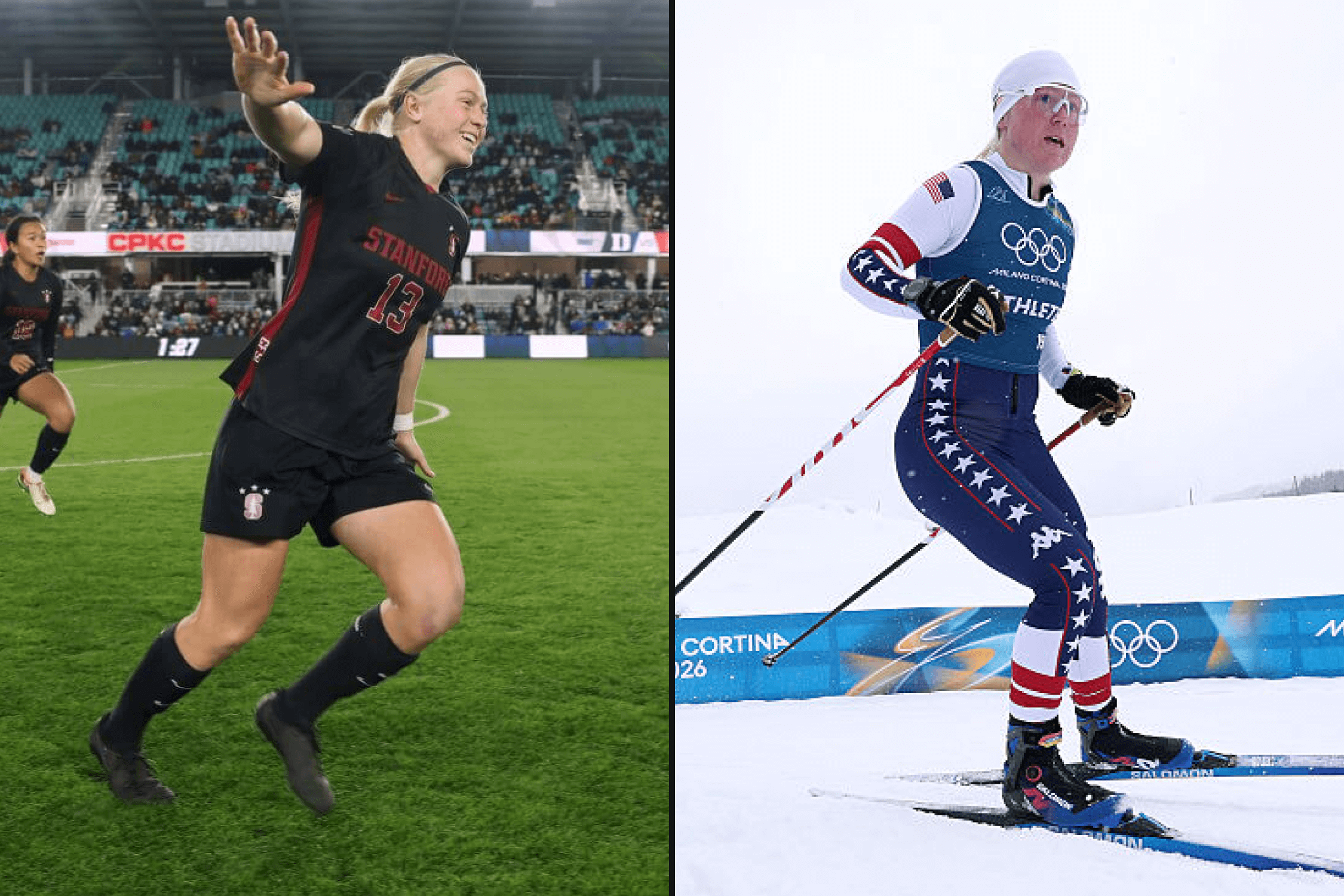
By The Athletic Staff
Sammy Smith’s Stanford biography still lists her major as “undecided,” yet the 20-year-old has already decided on something far more ambitious: racing for an Olympic medal in cross-country skiing barely two months after starting an NCAA championship final in soccer.
This week in Italy, Smith will line up for the United States in the Winter Games, completing a whirlwind transition from Cardinal centre-back to full-time ski athlete. The sequence defies conventional calendars. On Dec. 9 she anchored Stanford’s defence in a 1-0 loss to Florida State in the NCAA final; 48 hours later she was on snow in Alaska, finishing second in a U.S. SuperTour race that kept her Olympic qualification hopes alive.
“I had one shot,” Smith said of the condensed window. That shot came Jan. 17 in Oberhof, Germany, where a career-best World Cup performance locked up the last American berth in the women’s cross-country squad.
The dual-sport experiment has been years in the making. Raised in a household that encouraged seasonal sampling, Smith competed in as many as 11 sports annually—freestyle skiing, lacrosse, tackle football and track among them—before narrowing her focus to soccer and Nordic racing. Even then she refused to choose, spending last winter on the World Cup circuit, returning to Stanford for spring quarter, then repeating the cycle.
Her coaches have learned to expect the unexpected. After the Jan. 17 qualifier, Smith flew straight back to campus for final exams before re-joining the ski team for Olympic prep. “It’s not that I can’t decide,” she said. “I’d rather push limits.”
While Smith chases alpine glory, women’s soccer continues to attract headline-making investors. Pop icon Madonna watched two Tottenham academy matches over the weekend, supporting 13-year-old twins Stella and Estere, who play for Spurs’ under-14 girls side. Madonna’s presence—oversized sunglasses and all—rekindled memories of her Lisbon relocation in 2017 when son David Banda joined Benfica’s academy. Though historically linked to Chelsea through ex-husband Guy Ritchie and Blues board member Barbara Charone, Madonna spent the current visit on the Tottenham side of north London, underscoring Spurs’ expanding investment in girls’ pathways.
From music royalty to NBA royalty: Milwaukee Bucks forward Giannis Antetokounmpo has acquired a stake in Chelsea Women, partnering with Reddit co-founder Alexis Ohanian, who purchased roughly 10 percent of the reigning Women’s Super League champions last year. The deal continues a trend of basketball stars—LeBron James at Liverpool, Angel Reese at DC Power, James Harden at Houston Dash—placing financial faith in the women’s game.
Off the pitch, the sport’s accessibility is colliding with safety concerns. Liverpool midfielder Marie Hobinger told investigators she was stalked by 42-year-old Mangal Dalal, who sent messages saying “I know where you park your car,” then waited pitch-side after matches. Dalal received an 18-month community-service sentence and a two-year restraining order in January. The incident is part of a wider rise in threats, prompting Chelsea Women to end uncontrolled post-match autograph sessions and the Women’s Super League to monitor X’s AI tool Grok for generating sexualised player images.
Sammy Smith’s Olympic debut, Madonna’s academy tour and Giannis’s boardroom arrival all illustrate the expanding orbit of women’s soccer—an orbit now stretching from college stadiums to Olympic ski venues, from pop-concert sidelines to Premier League balance sheets.
Read more →Italians Strike Gold on Opening Day of Milan Cortina Olympics

Milan Cortina, Italy — The Milan Cortina Olympics burst to life with a wave of home-nation joy as Italian athletes mounted the medal podium repeatedly during the competition’s first full day of events. In a scene that organizers had envisioned when the Games were awarded to the Alpine region, the host nation collected multiple medals, instantly energizing athletes and spectators alike.
The early haul provided an emotional lift across venues, from the mountain clusters to the city-center ice rinks, and offered a storyline of national pride that Games planners hope will carry through the fortnight. While specific events and medal colors were not immediately detailed, the Italian surge was pronounced enough to dominate the opening-day narrative and set an upbeat tone for the remainder of the Olympics.
Local broadcasters looped footage of flag-draped athletes, and social channels lit up with celebratory hashtags within minutes of each Italian success. Organizers, who have stressed sustainability and regional flavor as cornerstones of these Games, welcomed the early good news as validation of years of preparation.
The early medal table now bears a distinctly Italian accent, and the host nation will aim to maintain momentum as competition intensifies across snow and ice through the final weekend.
SEO keywords:
Read more →Italians Strike Early on Feel-Good Opening Day of Milan Cortina Olympics

Milan Cortina, Italy — The host nation wasted no time giving the home crowd reason to cheer, collecting medals throughout the opening day of the Milan Cortina Olympics and setting an upbeat tone for the Games.
Italian athletes mounted the podium multiple times, turning the first medal sessions into a patriotic showcase that organizers hope will energize the fortnight ahead. While the specific events and medal colors were not immediately detailed, the early haul confirmed Italy’s intention to capitalize on home-field advantage.
Crowds waving the tricolor flag packed the venues and lined the approaches to the competition sites, creating a festival atmosphere that accompanied every Italian success. The early spree of hardware provided an emotional lift for both athletes and fans, underscoring the symbolic importance of strong performances on Day 1.
Local media hailed the surge as a promising sign that Italy’s investment in winter sport has paid immediate dividends, though officials cautioned that the schedule ahead remains long and demanding. Still, for a country eager to celebrate winter sport on home snow and ice, the opening chapter delivered a perfect narrative: Italians competing—and winning—before an adoring public.
Organizers will look to maintain the momentum as more medals are decided in the coming days, hoping the early triumphs translate into sustained energy across the entire Olympic program.
Read more →Milan Cortina Olympics Open with Multi-Site Ceremony, Marking a New Era for Winter Games

Milan Cortina, Italy — The Milan Cortina Olympics officially opened with a multi-site ceremony designed to celebrate the first Winter Games deliberately staged across a broad geographic footprint. Organizers embraced the Games’ spread-out nature, weaving together simultaneous performances and symbolic moments from venues spanning the Italian Alps to the Lombardy plains.
The ceremony’s decentralized format reflects the event’s logistical blueprint: rather than clustering in a single host city, competitions and festivities unfold in multiple locations. Spectators and athletes experienced a coordinated broadcast linking each site, underscoring the region’s diversity and the organizing committee’s commitment to accessibility.
The opening production highlighted local culture, winter sport heritage, and sustainability themes, aligning with the Games’ broader mission to showcase Italy’s alpine landscape while minimizing environmental impact. The multi-site approach also allowed smaller communities to share the global spotlight, turning mountain towns and urban centers alike into Olympic stages.
With the ceremonial start complete, attention now shifts to the days of competition ahead, as athletes navigate venues from the slopes of Cortina d’Ampezzo to the Milan metropolitan area, chasing medals in a Winter Games unlike any before it.
Read more →Milan Cortina Olympics Open with Multi-Site Ceremony to Launch Dispersed Winter Games

Milan Cortina, Italy — The Milan Cortina Olympics officially opened Friday with a multi-site ceremony designed to showcase a Winter Games that will be staged across a broad geographic footprint rather than a single host city. Organizers said the format reflects the region’s alpine geography and aims to bring the Olympic spirit to multiple communities.
The ceremony, held simultaneously at several venues, marked the formal start of the Games and underscored the organizing committee’s emphasis on sustainability and local engagement. Details of the performances, participants and schedule of events were not provided in the brief announcement.
The multi-site approach is expected to influence how spectators and athletes experience the Games, with competition clusters spread between Milan, Cortina d’Ampezzo and other mountain locations.
Read more →Milan Cortina Olympics Open with Multi-Site Ceremony for Dispersed Winter Games
Milan Cortina, Italy — The Milan Cortina Winter Olympics officially commenced Friday with a multi-site opening ceremony designed to unite a Games stretched across northern Italy’s mountains and cities. Organizers staged the event simultaneously at several venues to reflect the competition’s unprecedented geographic spread, marking the first time an Olympic opening has unfolded in multiple locations rather than a single stadium.
The ceremony’s decentralized format underscores the logistical challenge of hosting events from Milan’s fashion capital to Cortina’s Alpine peaks, with sliding sports in the Dolomites and ice hockey in the Po Valley. Spectators gathered at each site for coordinated performances that linked the regions through live video feeds and synchronized light displays, emphasizing the Games’ regional unity theme.
The International Olympic Committee approved the multi-site concept to reduce travel strain on athletes and fans while showcasing Italy’s diverse landscapes. Organizers say the model could influence future Winter Games planning as climate change and cost concerns reshape how host cities stage snow and ice competitions.
Competition begins Saturday across 16 disciplines, with medals awarded through the February 18 closing ceremony.
Read more →Milan Cortina Olympics Open with Multi-Site Ceremony, Ushering in a Spread-Out Winter Games
MILAN CORTINA — The Milan Cortina Olympics officially opened Thursday night with a multi-site ceremony designed to showcase a Winter Games that will be spread across northern Italy’s iconic cities and alpine resorts. Organizers said the decentralized format was chosen to highlight the region’s diverse landscapes and to allow more communities to share in the Olympic experience. Details of the performances, participants, and exact locations were not released, but the ceremony marks the formal start of competition that will unfold over the next two weeks.
Keywords:
Read more →The Latest: Two cauldrons are lit for the first time at a Winter Olympics

MILAN (AP) — The highly anticipated Milan Cortina Games have officially begun, marking the return of the Winter Olympics to Italy after a long hiatus. In a historic and unprecedented move, the opening ceremony featured not one, but two cauldrons being lit simultaneously, setting the tone for a spectacular and unforgettable event. This dual-cauldron ceremony was a first for the Winter Olympics, and it did not disappoint, as thousands of spectators and athletes gathered to witness the momentous occasion.
The ceremony itself was a masterful blend of Italian culture and sports, with references to iconic Italian figures and landmarks throughout. The event was held across four separate sites, each showcasing a unique aspect of Italian heritage and tradition. From the snow-capped mountains to the historic city centers, the Milan Cortina Games promise to be an exciting and action-packed celebration of winter sports. With a wide range of events and competitions scheduled to take place over the coming weeks, athletes and spectators alike are eagerly anticipating the opportunity to experience the best of Italian hospitality and sportsmanship.
As the two cauldrons were lit, the crowd erupted in cheers and applause, marking the official start of the Games. The ceremony featured a variety of performances and presentations, including musical and dance acts, as well as displays of Italian art and cuisine. The atmosphere was electric, with athletes from around the world gathering to represent their countries and compete in their respective events. With the Milan Cortina Games now underway, sports fans can expect a thrilling and unpredictable ride, as the world's top athletes battle it out for gold and glory.
The Milan Cortina Games are a significant event for Italy, which last hosted the Winter Olympics in 2006. The country has a rich history of winter sports, and the Games are expected to attract a large and enthusiastic crowd. With its unique blend of culture, tradition, and competition, the Milan Cortina Games are shaping up to be an unforgettable experience for athletes and spectators alike. As the event continues to unfold, fans can expect a wide range of exciting and unpredictable moments, from record-breaking performances to dramatic upsets and surprises.
Read more →Where are the next Summer Olympics in 2028? What to know
The 2028 Summer Olympics are scheduled to run from Friday, July 14 to Sunday, July 30, 2028, and they will be held in Los Angeles, California, United States. This will be the third time that Los Angeles has hosted the Summer Olympics, with the first time being in 1932 and the second time in 1984. The 2028 Olympics are expected to feature a wide range of sports, including track and field, swimming, gymnastics, basketball, and soccer, among others.
The 2028 Summer Olympics will be a major international event, with thousands of athletes from around the world competing in various sports. The Olympics will be held at several venues throughout the Los Angeles area, including the Los Angeles Memorial Coliseum, the Staples Center, and the Rose Bowl. The organizers of the 2028 Olympics have announced plans to use a combination of existing and new venues, with a focus on sustainability and reducing the environmental impact of the games.
One of the unique aspects of the 2028 Summer Olympics is the use of existing venues, which will help to reduce costs and minimize the environmental impact of the games. The organizers have also announced plans to incorporate new technologies, such as virtual and augmented reality, into the games. This will provide fans with new and innovative ways to experience the Olympics, and will help to engage a new generation of sports fans. The 2028 Olympics are expected to be a major success, with millions of people around the world watching the games on television and online.
In addition to the sports competitions, the 2028 Summer Olympics will also feature a range of cultural and entertainment events. These will include concerts, festivals, and other activities that will showcase the city of Los Angeles and its diverse cultural heritage. The Olympics will also provide a major economic boost to the city, with thousands of jobs created and millions of dollars in revenue generated. Overall, the 2028 Summer Olympics are shaping up to be a major event, with something for everyone to enjoy.
The International Olympic Committee (IOC) has announced that the 2028 Olympics will feature a number of new sports, including surfing, skateboarding, and sport climbing. These sports will make their Olympic debut in 2028, and will provide a new and exciting dimension to the games. The IOC has also announced plans to increase the number of female athletes competing in the Olympics, with a target of achieving equal representation between men and women.
The 2028 Summer Olympics are still several years away, but the excitement is already building. With its rich history, cultural diversity, and passion for sports, Los Angeles is the perfect city to host the games. The 2028 Olympics are expected to be a major success, and will provide a unique and unforgettable experience for athletes, fans, and spectators alike.
Read more →Winter Olympics 2026 Live Updates: Anti-ICE Protests Erupt in Milan Ahead of Opening Ceremony

The Winter Olympics is set to kick off today in Milan, Italy, with the highly anticipated opening ceremony expected to attract more than 70,000 people to the San Siro Stadium. However, the excitement and festivities have been somewhat overshadowed by the eruption of anti-ICE protests in the city. The protests, which have been ongoing for several days, have seen hundreds of demonstrators take to the streets to voice their concerns over the use of fossil fuels and the environmental impact of the games.
Despite the protests, the Olympic organizers have confirmed that the opening ceremony will go ahead as planned, with a spectacular display of music, dance, and culture expected to get the games underway. The ceremony will feature a parade of nations, with over 3,000 athletes from more than 90 countries taking part. The Italian team, led by flagbearer and Olympic champion, Sofia Goggia, is expected to receive a rousing reception from the crowd. The ceremony will also feature a special performance by Italian singer, Andrea Bocelli, who will sing the Olympic anthem.
The protests, which have been largely peaceful, have been organized by a coalition of environmental groups who are calling for the International Olympic Committee (IOC) to take greater action to reduce the carbon footprint of the games. The groups have criticized the IOC for its decision to partner with fossil fuel companies and for not doing enough to promote sustainable practices. The protests have also been supported by some of the athletes competing in the games, who have spoken out about the need for greater action to be taken to protect the environment. As the games get underway, all eyes will be on the athletes, but the protests are a reminder that the Olympics are not just about sport, but also about the values and principles that underpin the games.
The Winter Olympics will feature a range of exciting events, including alpine skiing, figure skating, and snowboarding. The United States, Norway, and Germany are among the favorites to top the medal table, but there are also hopes for a strong performance from the host nation, Italy. The games will run for the next two weeks, with the closing ceremony taking place on February 22. As the world watches the Olympics, the anti-ICE protests in Milan will serve as a reminder of the need for greater sustainability and environmental awareness in the world of sports.
The Olympic organizers have taken steps to reduce the environmental impact of the games, including the use of renewable energy sources and the implementation of recycling programs. However, the protests have highlighted the need for more to be done to address the issue of climate change and the role that the Olympics can play in promoting sustainability. As the games get underway, it will be interesting to see how the IOC responds to the protests and whether the Olympics can be a catalyst for positive change.
Read more →San Siro opens the Olympics: the Meazza as a home for global sport
The city of Milan is abuzz with excitement as the San Siro stadium, also known as the Stadio Giuseppe Meazza, prepares to host a prestigious event that will bring together athletes and spectators from around the world. Tonight at 20:00 CET, the iconic stadium will be the venue for the opening ceremony of the Olympics, marking a new chapter in its rich history. The San Siro has been the home of Italian football giants AC Milan and Inter Milan for decades, and its reputation as a world-class sporting venue is unmatched.
As the stadium opens its doors to the global sporting community, the atmosphere is electric. The sound of history is palpable, and the roar of the crowd is expected to be deafening. The San Siro has witnessed countless memorable moments in football, from championship wins to heart-stopping derbies, and now it is ready to host a new generation of athletes and fans. The stadium's state-of-the-art facilities and seating capacity make it an ideal venue for large-scale events, and its location in the heart of Milan provides easy access for spectators.
The Olympics promise to be an unforgettable experience, with thousands of athletes competing in a wide range of sports. The San Siro will be the hub of activity, hosting various events and ceremonies throughout the duration of the games. As the world watches, the stadium will be transformed into a vibrant and dynamic space, filled with music, color, and excitement. The opening ceremony will set the tone for the rest of the Olympics, and the San Siro is ready to play its part in making this event a success. With its rich history, world-class facilities, and passionate fans, the stadium is the perfect venue to host this global sporting extravaganza.
The anticipation is building, and the wait is almost over. As the clock strikes 20:00 CET, the San Siro will come alive with the sound of history, and the Olympics will officially be underway. The stadium will be a home for global sport, bringing together people from all corners of the globe to celebrate the spirit of competition and friendship. Whether you are a die-hard sports fan or just a enthusiast, the San Siro is the place to be tonight, as it opens its doors to the world and hosts an event that will be remembered for years to come.
As the world converges on Milan, the San Siro is ready to shine. The stadium's reputation as a world-class sporting venue is well-deserved, and its history is a testament to the power of sport to bring people together. The Olympics are a celebration of human achievement and perseverance, and the San Siro is the perfect venue to host this celebration. With its passion, excitement, and sense of community, the stadium will be the heartbeat of the Olympics, pulsating with energy and enthusiasm.
Read more →Olympics freestyle skiing schedule: TV channels, live streams, how to watch every freeski event at 2026 Winter Games

The 2026 Winter Olympics are just around the corner, and freestyle skiing fans are eagerly awaiting the start of the competition. With a wide range of events, including aerials, moguls, ski cross, halfpipe, and slopestyle, there's something for everyone to enjoy. If you're looking for ways to catch all the action, you're in luck. The Olympics will be broadcast on various TV channels and live streams, making it easy to watch every single freestyle skiing event from the comfort of your own home.
The TV broadcast schedule will vary depending on your location, but major networks such as NBC, CBC, and Eurosport will be providing extensive coverage of the Games. In the United States, NBC will be the primary broadcaster, with events airing on the main network as well as on NBC Sports and the Olympic Channel. Canadian fans can tune in to CBC, while those in Europe can watch on Eurosport. Additionally, many countries will have their own local broadcasters showing the events, so be sure to check your local listings for more information.
For those who prefer to stream their content, there are plenty of options available. The Olympic Games will be available to stream on the official Olympics website and mobile app, as well as on various streaming services such as Peacock, Hulu, and YouTube TV. These services will provide live and on-demand coverage of every freestyle skiing event, so you can watch at your convenience. Furthermore, many TV networks will also be offering live streams of their broadcasts, allowing you to watch on your computer, tablet, or smartphone.
In terms of the competition itself, the 2026 Winter Olympics promise to be an exciting event. The world's top freestyle skiers will be competing in a range of disciplines, with medals up for grabs in each event. The aerials competition will feature skiers performing high-flying stunts and tricks, while the moguls event will see athletes navigating a challenging course filled with bumps and jumps. The ski cross competition will be a thrilling event, with skiers racing down a challenging course filled with jumps and banked turns. The halfpipe and slopestyle events will showcase the skiers' technical skills, with athletes performing complex tricks and combinations.
With so many ways to watch and a wide range of exciting events to look forward to, freestyle skiing fans are in for a treat at the 2026 Winter Olympics. Whether you're watching on TV or streaming online, you won't want to miss a minute of the action. So mark your calendars, set your reminders, and get ready to cheer on your favorite athletes as they compete for gold in the thrilling world of freestyle skiing.
Read more →Olympics Nordic combined schedule: TV channels, live streams, how to watch every event at 2026 Winter Games

The 2026 Winter Olympics are just around the corner, and fans of Nordic combined are eagerly anticipating the action-packed events that will unfold in the Italian Alps. Nordic combined, which combines cross-country skiing and ski jumping, is one of the most thrilling and technically demanding winter sports, requiring athletes to possess a unique blend of endurance, strength, and agility. For those who can't make it to the Olympics in person, there are plenty of ways to catch every moment of the Nordic combined events from the comfort of your own home.
The NBC Olympics website and app will provide comprehensive coverage of the 2026 Winter Games, including live streams of every Nordic combined event. Fans can also tune in to NBC, NBCSN, and the Olympic Channel to catch the action on TV. Additionally, streaming services such as Peacock and Hulu will offer live and on-demand coverage of the Olympics, giving viewers even more options to stay up-to-date with the latest developments. With so many ways to watch, fans won't have to miss a single moment of the Nordic combined competition, from the individual normal hill/10km events to the team large hill/4x5km relays.
The Nordic combined schedule is packed with exciting events, kicking off with the men's individual normal hill/10km competition on February 12. The women's individual normal hill/5km event will follow on February 14, with the team large hill/4x5km relay taking place on February 18. The individual large hill/10km competition will wrap up the Nordic combined program on February 20. With a talented field of athletes from around the world, including reigning Olympic champions and up-and-coming stars, the Nordic combined events are sure to be some of the most compelling and unpredictable moments of the 2026 Winter Games. Whether you're a die-hard fan of the sport or just looking for some exhilarating winter sports action, the Nordic combined events are not to be missed.
To get the most out of your Olympic viewing experience, be sure to check the NBC Olympics website for the full Nordic combined schedule, including start times, TV channels, and live stream information. You can also set reminders and alerts to ensure you don't miss your favorite events or athletes. With the Olympics just around the corner, now is the time to start planning your viewing schedule and getting ready for the thrill of Nordic combined competition.
Read more →